Connection and the Long View: Steph Fregosi on Sustainability and AASHE
By Roya Ojarood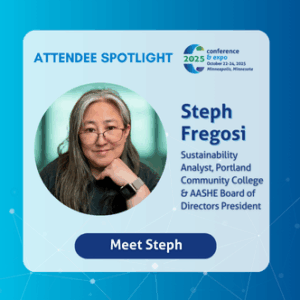
My final interview for this project was with Steph Fregosi, who has been the Sustainability Analyst at Portland Community College since 2018 and is currently the AASHE Board of Directors President. Steph has spent about fourteen years in the world of sustainability and higher education, so she’s been around long enough to notice what has changed and what hasn’t. At PCC, Steph manages greenhouse gas reporting, renewable energy data, and climate planning efforts— anything that supports the college’s carbon commitments as well as its comprehensive sustainability goals. She also leads the tracking and reporting required for STARS (higher education’s sustainability rating system). Though Steph’s role isn’t just about data— it’s about building connections with other people, which was a theme that appeared again and again as our dialogue went on. Our conversation made clear to me how her work and perspective have been molded by two things: an insistence on the value of connection and a long view of what sustainability has the potential to, and can, accomplish.
Steph first turned to AASHE when she was a new sustainability professional— the “first person in [her] position” at the time— looking for a roadmap. “I really didn’t have any reference tools for what good campus sustainability indicators were,” she said. She explained how AASHE became that tool by not only offering resources, but also a way to see how other institutions, like community colleges, were grappling with similar challenges. “Attending the conference let me network with so many different people and hear directly from them about how their projects performed,” she explained. Her ability to adapt, compare, and learn from others is foundational to what she does. However, years later, Steph’s reasons for participating in and attending the conferences have evolved: “As I’ve matured and become more of a practitioner, it’s been a really great way to keep in touch with people, find out what’s current, what’s really trending, and then hear from some really amazing keynote speakers,” she said, happily. This year, she is especially excited to hear Dr. Ayana Elizabeth Johnson speak. “Hearing her live… I’m going to die!” she said with a chuckle. That mix of excitement and stability— knowing sustainability work is serious but also human— ran throughout our conversation.
Steph imagines the conference as more than an event: “Showing up for this is really key,” she said. “There’s going to be this opportunity at this year’s conference to just be together, in community, with one another.” For her, connection is not a luxury, but a requirement for doing work in sustainability. “When you work in isolation, that is how you forget that you do this work for future generations in support of, and connected to, each other,” she explained. “The more you are connected to people, in-person, the easier it is to do the work.” She described the conference as an opportunity to “fully charge your battery, collect ideas… inspiration,” which is an antidote-mindset to the fatigue that can build up in a field where progress is often incremental.
At this point, our conversation turned to how she personally defines sustainability. For Steph, sustainability is about ensuring that “people [can] live on a healthy and happy planet for future generations to come,” including her own child. She framed sustainability as proof that there can be “justice and fairness and meaning in the universe,” and that “if you want to prove that humanity is somehow sustained, this is how we do it.” This combination of pragmatism and existential hope reflects the maturity she sees across higher education as a whole. And then, reflecting on the last AASHE Conference she attended, Steph recognized a change. Post-pandemic, she sensed a “different” energy in the room but also a growing sense of accomplishment. “The thing that I really reflected on at the last conference is the maturity level of sustainability in higher education,” she noted. “We’re really getting there.” For her, telling that story and recognizing the progress made over decades is essential to empowering both students and practitioners to keep pushing on. More storytelling, she believes, is exactly what can move people out of existential dread and into action: “We need to do better at both telling our story about sustainability in higher education and individually on our own campuses.”
This fall, Steph will return to Minnesota to speak on STARS 3.0 at the AASHE Conference. For her, though, the conference is not just an opportunity to present, but about gathering what others who are trying, often against long odds, to create a more sustainable future. “I need that sense of connection in order to continue doing the work,” she told me. “I cannot do without it.” Her persistence and determination to measure progress, build relationships, and stay connected is what has carried her through fourteen years in higher education sustainability and into leadership at AASHE. As she put it, the conference is where people come together to share a sense of purpose. For anyone attending this year, her advice is implicit in her example: show up, listen, and connect. In a field defined by collective action and long timelines, the connections made may be the most sustainable thing of all, so her example provides a simple reminder: showing up matters.