Kate M. Nelson’s Take on Sustainability, Community, and AASHE Conferences
By Roya Ojarood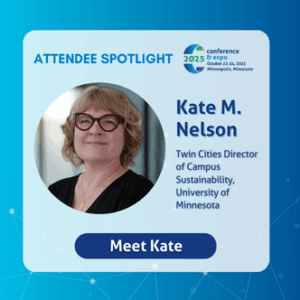
I met Kate one early morning in June, and I remember being nervous to begin the interview. We had only just begun the call when her warmth and ease came through my computer screen. The calmness of her attention, the way she laughed when recalling memories, and the clarity with which she spoke about her work stood out to me. I had brought my questions, but with Kate, the conversation never felt, to me, like an interview— it felt like what she, herself, looks forward to at AASHE conferences: a hallway conversation.
Most of the questions I asked revolved, of course, around the topic of AASHE conferences, but also about what working in sustainability means, what’s important to keep in mind, as well as more directed questions involving higher education. Kate is the type of person who values relationship building and forming deep connections with other professionals in sustainability. When talking about one of her favorite aspects of attending an AASHE conference, she told me, “It’s [all about] the people. I just really look forward to the people. To be honest, there are so many sessions that are fantastic, of course, but I always try to find something… that is a little bit different. There is always something to search out that you didn’t know you were looking for.” That’s not just talk— she has built her entire approach to sustainability around connection: Not checklists or metrics, but intentionality when meeting someone new or revisiting conversation with acquainted colleagues.
One of the stories Kate shared with me was of a past AASHE conference, where she made one of the most meaningful professional connections in her life. It happened accidentally, during a moment of downtime, while she was sitting on the floor in quiet, relaxing. “Shane [Stennes] came up and talked with me,” she said. At this point in her career, she wasn’t working in her current position and wasn’t as acquainted with Shane, but she really respected and admired what the University of Minnesota was doing at the time. “Ever since then, I knew he was someone I could go back to, to call on, to share information.” That kind of recognition and click of connection that turned out to be long-lasting is, in many ways, what she sees as the heart of AASHE’s conference experience. “We need each other. We need to rejuvenate each other.”
During our discussion on what sustainability means to her, Kate reflected on the deep tie of her work to her everyday life. “Living an intentional life,” she said, “means understanding the choices we make.” She emphasized the community aspect to living an intentional, sustainable life: Everyday, we pass by so many people— people who see and interact with the same things do— who deserve the right to live in a healthy, walkable environment with easy access to nature. From both the individual and community perspective, the most important thing is to lead a life of intention, but to also allow for grace so as not to burn out. Sustainability is a framework that guides everything in her day-to-day life: how she commutes to work, how she builds equity into climate policy at the University of Minnesota, and how she approaches the AASHE Conference year after year. This year, she has no intention of being a passive observer, but to be a good host, a welcoming presence, and a connector.
Now, for the educational aspect: In her role as Director of Campus Sustainability, Kate is actively pushing for change that is both personal and systemic. She doesn’t believe in huge splashy solar projects that cut communities out of the process, but for helping to give back to the community and build a richer life for more people. Too, at the core of her philosophy is a belief in education as a space of experimentation: “A lot of people think universities are too staunch and don’t take risks,” she told me, “but the whole idea of academia is to explore and try new things.” So, from off-site solar work to equity-first climate work, Kate sees her position as relational rather than static. She is embedded in place, process, and, above all, people. “We are place-based,” she said firmly. “University of Minnesota Twin Cities is not gonna get up and go anywhere. We serve this community and this state… We represent well. We will always be here.”
The longevity of Kate’s career, along with her conference attendance, and relationships mirrors this idea of staying, of showing up again and again, and of letting the familiar evolve. When attending the AASHE Conference this October, it is crucial to stick around to listen, network, and expand your awareness of what sustainability in higher education means. “It took a retreat I did 13 years ago to really dive deep into what AASHE was and what I could make of it… If you don’t engage, or go to the after-hours things… you just won’t get the value out of it.”
I loved how Kate revealed the aspects of community, grace, joy, and intention that guides her through her work in sustainability and higher education. Rather than focusing on or getting bogged down by feeling of sacrifice or burnout, she holds true to the continued belief of doing the right thing for the places she inhabits and the people she comes in contact with. By the time it got to the end of our conversation, I realized that people, like her, bring a warmth to this field. Like she said, “These people become friends. We do business together. We collaborate. We have a lot of respect for each other.” And this October, when Kate shows up to AASHE again, it won’t be because she has to, in her hosting position. It will be to keep the hallway conversations going, to host well, to build connection and trust, and to have fun. Maybe, if you’re lucky, reader, you’ll see her as a familiar face during a quiet bonding moment between sessions.
P.S.: Kate encouraged me to promote the Amtrak and to inspire people who are traveling long distances to take the train: “I’m going to challenge people to take the Amtrak. We have a great train station in St. Paul that comes from the West and out of Chicago… You can hop on the Green Line and get to the conference really easily.”