Looking Ahead to AASHE: Insights from Megan Butler
By Roya Ojarood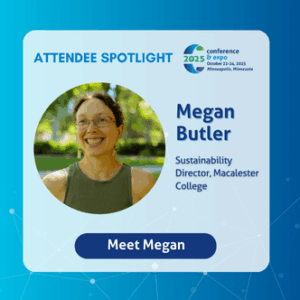
My interview with Megan occurred outside on a warm July morning. It was a beautiful day: Sunlight was filtering through the trees and spilling onto the lawns across Macalester College’s campus. The campus was quiet, safe, and colorful. Megan Butler, the college’s Sustainability Director, greeted me when I arrived. Our conversation took place in a place of shade, and when we wrapped up, Megan kindly offered to show me around parts of campus included in the college’s “Tree Tour.” Macalester, I learned, is both an arboretum and a home base for sustainability work powered and shaped by values of care, collaboration, and equity.
Megan’s path into the field started with people. She told me that, as an undergraduate, she “had a professor who was super passionate about [sustainability]” and who inspired her to follow those passions, igniting a career path in sustainability. That spark, combined with her own interest in, and connections to, the outdoors led her to pursue a Ph.D. in the University of Minnesota’s Environmental Sciences, Policy and Management program. Since then, she has taught in college settings, worked in the Energy Transition Lab, and, of course, grown into her leadership role as Sustainability Director— all while staying closely anchored to the people around her. When I asked her what drew her in and continues to keep her committed to sustainability, she simply answered, “Passionate people… They energize me!”
Megan has attended multiple AASHE Conferences over the years. Her first time attending was in San Antonio for the 2017 conference. She described that experience as one where “Everyone was really supportive.” That word— supportive— came up many times during our conversation. It’s how Megan describes the Macalester community and it is what she values most about AASHE spaces. At the Boston conference, she found herself participating in various meaningful hallway conversations and networking dinners that made her work feel less isolating. “It’s comforting,” she told me, “to find similar people in similar jobs and with similar life paths.” The sheer range of participants at the conferences, and their openness to sharing ideas, stands out. She added, too, that at the conferences she’s attended, “People were translating theory into action in a way that I myself am drawn to.”
In her role at Macalester, Megan works closely with students on a wide range of initiatives: From campus gardens to mutual aid efforts, a reuse center, and food recovery programs, student priorities and questions frequently shape the direction of the office’s work. “We serve the students,” she said proudly. “Everything we get done is because of students.” Right now, her team is focused on getting from ‘almost there’ to ‘all the way’ by trying to close the last 15-20% gap on goals involving carbon neutrality and zero waste. It’s a challenge that requires serious creativity and collaboration. She told me “we’ve made a lot of progress, but the last stretch is a lot more strenuous.”
This, I think, is where conferences like AASHE’s come in. Megan values the chance to hear how other campuses are tackling the same problems, more specifically when it comes to decarbonization without offsets, zero-waste strategies, or rewilding efforts. The conference offers a space “to be able to talk shop… It brings in a whole bunch of people who wouldn’t otherwise be able to travel to a far away conference.” Here, she was speaking of Minnesota locals, insinuating that the opportunity is greater for people nearby to come together, talk shop, and ultimately collaborate on prevalent obstacles within the field.
When I asked her what she hoped people would take away from her presence at AASHE this year, she completely lit up: “I’d be really excited to talk about the things that I like, personally and professionally… community governance of natural resources, forestry, urban forests, food production in urban settings.” I’ll add teaching, too, because she is interested in how all of these pieces connect across disciplines, campuses, as well as conversations within the realm of higher education.
At the conclusion of our talk, she said something that stuck with me: sustainability isn’t as simple as recycling, or even partaking in a non-disposable way of life— it’s about taking into account human (and environmental) well-being and longevity. The projects we do need to last and ideas must take root. And, the work— when it is achieved with others— has the ultimate power to stretch way beyond where it starts.
Say “Hi” to Megan at the conference— I am sure that you will be met with a smile and very meaningful conversation!