Reflections from Stephen Ellis
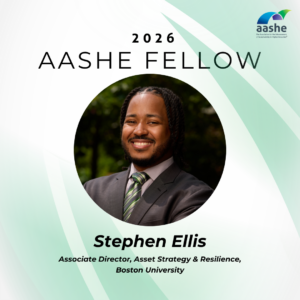
Stephen Ellis, associate director of Asset Strategy & Resilience at Boston University, recently took on a new challenge in his sustainability career. After years working in sustainability data analytics, he transitioned into facilities asset management and resilience, where he now helps guide long-term decisions about campus buildings, infrastructure, and capital planning. The shift has broadened his perspective on sustainability, revealing how environmental goals, operational priorities, and financial stewardship intersect over the lifecycle of institutional assets.
In this AASHE Fellows spotlight, Stephen shares insights from his recent transition into asset management, discusses the role campuses play in shaping future sustainability leaders, and reflects on the value of curiosity, mentorship, and professional community.
What are you learning at this stage of your career about sustainability in higher education?
As of September 2025, I have transitioned from sustainability data analytics to focus on facilities asset management strategy and resilience, learning to pivot from standalone sustainability initiatives to integrating sustainability as a vital part of the lifecycle of buildings, infrastructure, and systems. In my new role, I oversee Boston University’s (BU’s) efforts to reduce deferred maintenance, extend asset lifecycles, and align capital planning with the University’s Climate Action Plan. Through this work, I am learning what it takes to build and maintain a comprehensive capital asset inventory and, more importantly, how that data can inform better decision-making over decades, not just years.
Thus far, what has stood out most is the complexity of balancing operational needs with sustainability goals, while translating those priorities into long-range strategies that deliver lasting impact for BU.
What motivates you to work towards the advancement of sustainability in higher education?
I am motivated to advance sustainability in higher education because it is one of the few sectors that both shapes future leaders and, in certain cases, operates like a small city. That combination creates the opportunity to influence not only how people think about sustainability, but how they experience it in their daily lives. What drives me is the idea that students can encounter sustainability in both visible and subtle ways, whether through data and reporting, communications, campus buildings, academic coursework, and/or sustainability groups and offices. Even a single data point, building system, or interaction can spark awareness and curiosity.
I often think about how the systems and spaces we manage contribute to that experience. If we can embed sustainability into the physical and operational fabric of a campus, we create a living learning environment where students don’t just study sustainability, they see it in action. My hope is to help develop more change agents who take the time to reflect on sustainability, whether in their individual decisions or in how they lead organizations.
If you were speaking to your younger, early-career self, what nugget of wisdom would you share?
If I could offer my younger, early-career self advice, I would tell myself to intentionally invest in relationships and not hesitate to lean on others. Early on, it can feel like asking for help is a burden or a sign of not knowing enough, but I have learned that those moments are often where the most meaningful growth happens.
The field of sustainability in higher education can be complex and, at times, uncertain to navigate. Having a network of peers, mentors, and colleagues to exchange ideas with has been invaluable, not only for problem-solving but also for gaining new perspectives and building confidence. Over time, I’ve realized these relationships are foundational, and that staying curious, connected, and open to others’ perspectives helps you grow in the work – often through “nuggets of wisdom” that may surprise you.