Reflections from Krista Hiser
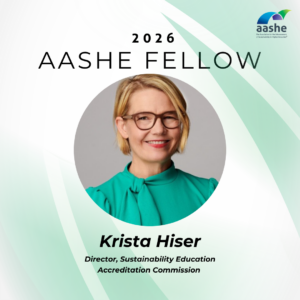
For more than two decades, Krista Hiser has worked at the intersection of sustainability, teaching, and institutional change, guided by a simple but powerful question: What do students know, think, feel, and do about sustainability and climate change? Now, as director of the Sustainability Education Accreditation Commission, she is focused on strengthening the quality and impact of sustainability education across higher education.
As part of the 2026 AASHE Fellows recognition, Krista reflects on the value of systems thinking, the responsibility educators have to prepare students for a changing world, and the relationships and shared purpose that have shaped her professional journey.
What are you learning at this stage of your career about sustainability in higher education?
One of my favorite mantras from design thinking is “Put it in a Bigger Box.” After 25 years as a faculty member, I see my career like an expanding fractal. I began by looking for sustainability practices within my own home and personal life. As my perspective grew, the “box” expanded to my classroom and curriculum, then to the department level, and the University of Hawaii’s ten campus system.
I am learning that the most impactful work happens when I start thinking at a systemic level. My current career chapter is focused on this broader horizon—working with organizations like AASHE to build relationships and strengthen networks for regional, national, and international standards and program outcomes for sustainability education.
“Mid-career” feels like the stage in my career where I’m starting to see the biggest box of all…which, it turns out, isn’t actually a box at all but more like a great cosmic mobius strip…
What motivates you to work towards the advancement of sustainability in higher education?
For twenty years, my work has been anchored by the question: “What do students know, think, feel, and do about sustainability and climate change?”
This inquiry drove my dissertation, my academic blog, “Field Notes: Teaching Climate Change in Higher Education”, the “Worry & Hope” paper, and decades of classroom discussions. I am motivated by curiosity and also a profound sense of obligation. Our universities are the unique spaces where the communication and translation of climate science into human wisdom happens—or fails to happen.
The lack of real climate education and preparation is a massive blind spot in higher education. What motivates me is a desire to look my former students in the eye twenty years from now, in a world that is inevitably hotter and harder, and know that I did not fail them, so that no student ever says to me, “Why didn’t you prepare me for this?”
What professional achievement or accomplishment are you most proud of?
Honestly, I’m proud of the accomplishment of receiving this AASHE Fellows Award!
My first AASHE conference was 2011 in Pittsburgh, where I remember mapping out my dissertation with a bunch of post-it notes in the conference center lobby, entirely energized by the “buzz” of the conference. A couple hundred presentations, posters, workshops, and meetings later, I have developed meaningful, impactful, and fun relationships in the field of Sustainability in Higher Education. To me, this award represents a reputation for consistently showing up—contributing soundly as a connector, a mentor, a colleague, a friend, and, of course, a teacher. That’s something to be proud of and I truly wouldn’t have had the career that I’ve had, without AASHE.
I’m in the process of retiring from my faculty position, so this award opens a new chapter, as I focus full-time on developing the Sustainability Education Accreditation Commission, an emerging third-party accreditor for Sustainability degrees and certificates. I think this work complements STARS and will raise the quality, visibility, and value of Sustainability as a degree field and as a profession. That’s the new goal!