Sustainability literacy is a topic of increasing interest among a growing number of higher education sustainability staff and faculty. Formal education programs and courses that address sustainability are becoming increasingly common. However, there currently exists no standardized tool or method to assess the sustainability literacy of students. Although the concept is not new, and discussions have occurred in the past, new conversations have emerged, in part because of preparation for STARS version 2.0 and research that other institutions have completed in this area.
This blog article focuses on current STARS data for ER 13: Sustainability Literacy Assessment. It also looks at the results from a recent campus survey from Ohio State University that was presented at AASHE 2012. Finally, it concludes with ideas and opportunities for collaboration.
The Challenges of Conducting Sustainability Literacy Assessment
STARS Fact
Within the ER category of STARS, the lowest-scoring credit based on average percent of applicable points earned is ER 13: Sustainability Literacy Assessment. With two points available for the credit, one point is awarded for conducting an assessment of sustainability literacy of students, while two points are awarded for also conducting a follow-up assessment of the same student cohort. STARS reports showed that 21% of institutions conducted an assessment of student sustainability literacy, but only 12% of institutions received full points by also conducting a follow-up assessment.
The challenges to conducting sustainability literacy assessment are numerous, at least partly explaining the low scores in ER credit 13.
- Developing an assessment and methodology that provides meaningful results can be difficult
- Analyzing and interpreting the results can be time-consuming
- Buy-in from administration may not be there
- Students may already be experiencing survey fatigue
- No central assessment tool currently exists
There exists room for improvement and fortunately, there is a growing interest and enthusiasm on the topic of sustainability literacy assessment. At the AASHE 2012 conference in Los Angeles, Adam Zwickle and Tom Koontz from the Ohio State University (OSU) engaged participants in a discussion and presentation on the research findings from OSU’s sustainability literacy survey.
Implementation: OSU’s Sustainability Literacy Survey
Faculty and students at OSU’s Environmental and Social Sustainability (ESS) Lab developed a sustainability literacy survey instrument to measure multiple domains of sustainability knowledge. STARS’ ER credit 13 was cited as among the drivers for developing the instrument.
OSU’s sustainability assessment measured knowledge of sustainability as well as student values and beliefs in two survey segments. The sustainability knowledge segment was is built upon a “triple bottom line” approach, including an equal number of environmental, social, and economic questions. This portion of the survey included 30-questions on sustainability literacy, though this was later reduced to 16 questions. With several value-based questions included, the survey was sent via email to 10,000+ undergraduate students at OSU. Although no participation incentive was used, non-response email follow-ups were sent to help boost participation.
Results: Sustainability Literacy at OSU
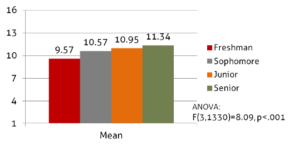
OSU’s survey ultimately garnered a 19.3% response rate – a higher-than-expected rate, according to OSU researchers. The overall average score for OSU undergraduates was 69%. On average, students answered correctly 73% of environmental questions, 71% of social questions, and 61% of economic questions. A gradual increase in scores according to class level was found to be significant, as depicted in the graph below.
OSU Sustainability Literacy Results by Class Level
 OSU researchers are using data collected from both portions of the survey to test for correlations between sustainability literacy and student values, attitudes, and behaviors. The findings suggest that, although respondents tended to have slightly more liberal and environmentalist views, these differences were found to be non-significant. Researchers also found that students who took the survey only after complying with one or more requests for follow-up were slightly more likely to get a subset of the sustainability knowledge questions wrong.
Opportunities for Collaboration
An outcome of the discussion following the OSU presentation was a strong desire to collaborate in the development of a common assessment tool that could be used by numerous colleges and universities. OSU researchers have spoken with representatives from several institutions, though commitments have not yet been made. Through this blog, AASHE hopes to further raise awareness on the topic of sustainability literacy assessment, and continue the dialogue on collaboration for the development of a common tool.
Should AASHE take a role in leading the development of a common sustainability literacy assessment tool? If so, in what specific ways can AASHE assist in the process? Readers can contribute to the dialogue by providing feedback below, or they can ask questions and provide suggestions at stars@aashe.org.