
If you’ll be in town a little early for the conference, sign up now for a pre-conference Experiential Learning Opportunity (ELO) or a Workshop. Both types of activities occur early in the day on October 22, before the official start of our conference program, and cost an additional fee. These supplemental opportunities offer educational opportunities not found in our standard conference program to help maximize your time in Minneapolis.
- Experiential Learning Opportunity – An opportunity to leave the conference hotel and explore Minneapolis. The University of Minnesota has put together 3 activities, highlighting various elements of campus life and sustainability in Minneapolis, providing inspiration and ideation as you take in the sites.
- Workshops – Looking for more hands-on opportunities to hone your skills while you’re in Minneapolis? Check out one of our three pre-conference workshops, designed to go more in-depth than most conference sessions and allow you to the opportunity to workshop specific areas of your work.
Experiential Learning Opportunities ($)
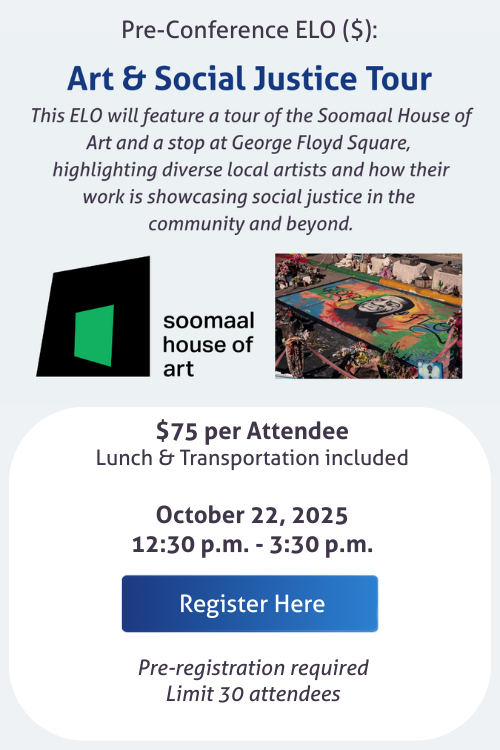
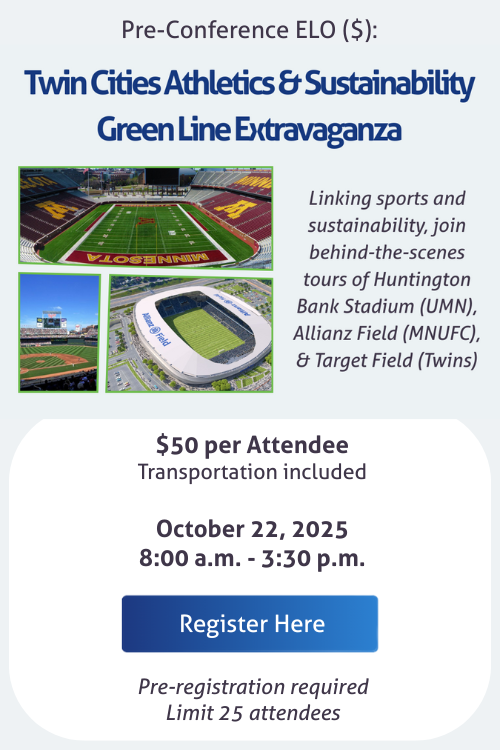
- Learn MoreThis session explore the connection between art and social justice. The tour will highlight various diverse local artists and how their work is showcasing social justice in the community and beyond. This ELO will feature a tour of the Soomaal House of Art and a stop at George Floyd Square. More details of each tour stop will be coming soon!
- Learn MoreJoin the University of Minnesota and the Zero Waste Campus Council for an engaging, hands-on workshop focused on real-world zero waste solutions! The day begins at the Hyatt Regency Minneapolis (the conference hotel) with a presentation and virtual tour of Eureka Recycling’s Materials Recovery Facility (MRF). Eureka is a nonprofit zero waste organization and social enterprise recycler based in Minneapolis, leading innovative approaches to waste reduction and community engagement.
Attendees will pick up a boxed lunch as they take a shuttle bus to the University of Minnesota Reuse Program warehouse to learn how the university repurposes surplus materials from over 250 campus buildings. You’ll hear directly from program staff about operations, impact, and sustainability goals. The University of Minnesota will present highlights of their work, including green labs, climate action planning, and the campus walking sustainability tour. In the afternoon, attendees will split into smaller groups to tour the university’s on-site MRF or explore the reuse warehouse and connect with peers. If you are flying in later than 10 you can still join the workshop. Lunch and transportation are included with the registration fee.
- Learn MoreJoin us for the Twin Cities Athletics & Sustainability Green Line Extravaganza! Come get an inside look at some of the most iconic sports venues in the Twin Cities. You’ll get behind-the-scenes tours of Huntington Bank Stadium (UMN), Allianz Field (MNUFC), and Target Field (Twins). Linking sports and sustainability, the tour is also a chance to explore the city in a sustainable way. We’ll be using the Green Line to travel between each stadium, giving you a hands-on opportunity to familiarize yourself with Metro Transit options. Food and Drinks are not included, but a lunch stop will be made at Malcolm Yards.
Instructions will be provided and a UMN staff member will meet with participants at the Hyatt Regency early in the morning of the 22nd to get Day Passes to the Green Line (if wished for, numerous Metro Transit options exist for attendees during the week). Attendees may alternately meet with the group directly at the Jackson County /Administrative Entrance off 23rd Avenue (near the Green Line Stadium Village Station).
Pre-Conference Workshops ($)
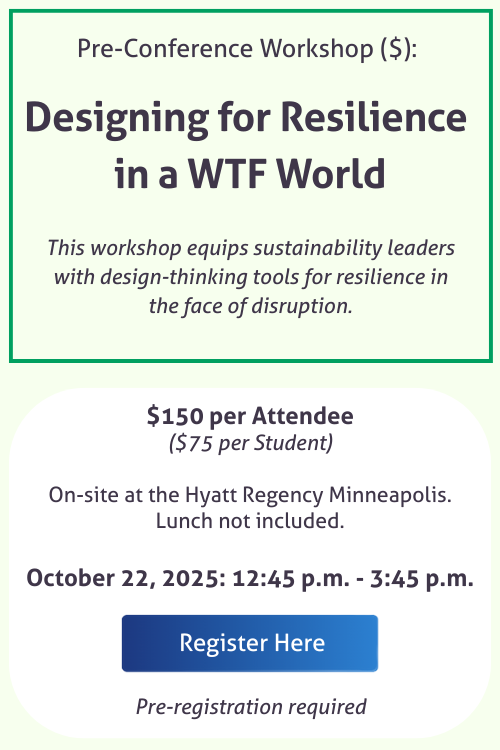
- Learn MoreDesigning for Resilience in a WTF World is an engaging and hands-on professional development workshop designed specifically for sustainability practitioners working in higher education. In today’s complex landscape, where political pressures, cultural clashes, and institutional inertia often collide, this workshop offers tools, mindsets, and creative strategies to help participants navigate uncertainty and design for resilience. Rooted in the principles of Design Thinking, this 3-hour workshop equips participants with a powerful framework to reimagine campus sustainability efforts with empathy, adaptability, and impact. Through a mix of collaborative activities and reflection, participants will explore how to approach their work like designers: with curiosity, openness, and a readiness to experiment. Participants will be introduced to key design thinking stages (empathize, define, ideate, prototype, test) and gain familiarity with essential designer mindsets such as embracing ambiguity, learning from others, and build and craft intentionally. Using one central challenge attendees will work in small groups to apply these tools in real time. Together, we’ll map challenges, identify stakeholder needs, generate bold new ideas, and prototype low-resolution solutions, all in a safe, playful environment that encourages creativity and collective learning. By the end of the workshop, participants will leave with a resilience “toolkit” tailored to their campus context, a reframed sense of what’s possible, and a renewed energy to lead sustainability efforts that are grounded in adaptability, inclusivity, and hope. This session is ideal for professionals who are tired of reactive problem-solving and ready to build more intentional, sustainable systems. Whether you’re a seasoned leader or early-career practitioner, this workshop invites you to step out of the weeds and into a space of imagination, strategy, and design. We can’t promise to fix the world in three hours—but we can help you face it with sharper tools, a fresh mindset, and a community of co-conspirators who know exactly what it means to do this work in a WTF world.
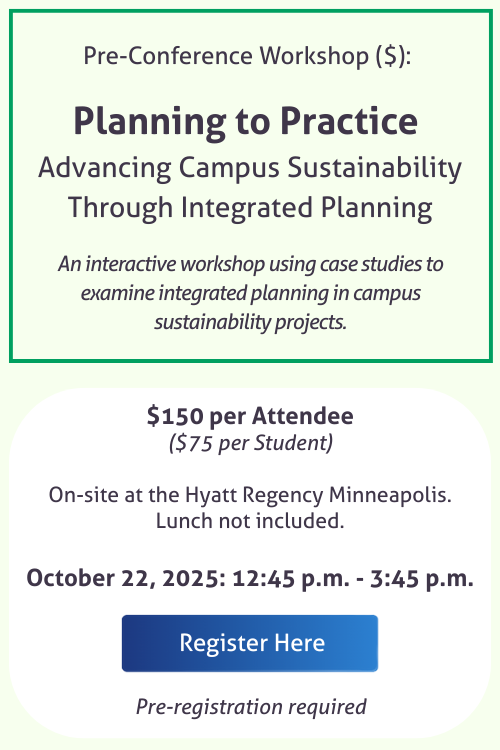
- Learn MoreThis interactive workshop, “Planning to Practice: A Case Study Approach to Campus Sustainability,” explores the effective application of integrated planning principles to sustainability projects in higher education. Participants will learn how aligning sustainability initiatives with the institution’s broader mission and strategically engaging diverse stakeholders can enhance project success. The workshop will broadly cover the foundational elements of integrated planning in the context of campus sustainability. Through a comprehensive institutional case study, participants will gain practical insights into how effective integrated planning can contribute to the development and implementation of impactful and enduring sustainability efforts. By the end of the workshop, participants will understand the key stages where integrated planning enhances project success and the overall importance of a holistic and collaborative approach to campus sustainability.
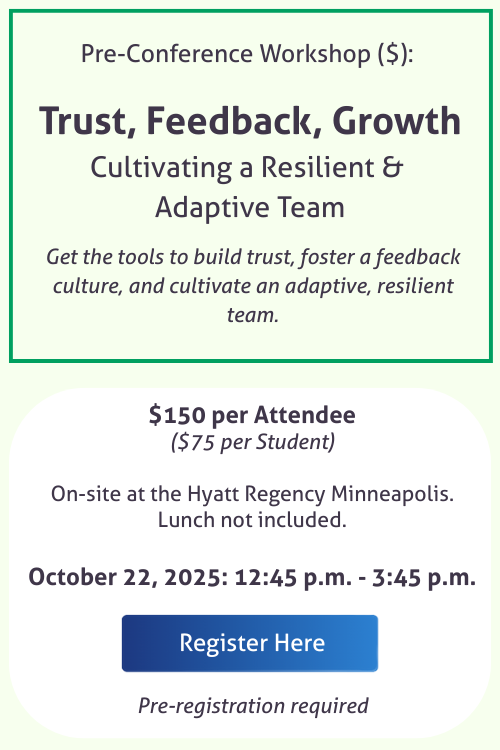
- Learn MoreTo move at the pace demanded by the climate crisis will require quick feedback loops and ongoing iterations of our work. A team can be stacked with talent – but if there is a deficit of trust, the organization functions in disparate parts. Safety and trust are interchangeable. Without trust, we move around very cautiously. It slows us down. Trust, Feedback, and Growth was designed to provide participants with the vocabulary, tools, and framework to begin to understand and foster trust, operationalize feedback, and grow an adaptable and resilient team. This two-hour session will be broken into three parts. The first part will focus on the individual. Participants will be led through self-reflection activities, an essential starting point to becoming a good communicator with others. In the second part of the workshop, participants will bring the insights they learned from their reflections and apply them to interpersonal relationships. They will learn how to prepare for, and have, difficult conversations, develop a shared vocabulary to engage in conflict, and tools and resources for creating a feedback culture in your organization. Activities will encourage participants to get curious about past interactions – understanding why feedback fell flat or didn’t go as planned. Participants will also have time to practice preparing for interpersonal challenges they face in their work and beyond. Finally, participants will learn how the first two sections are the essential building blocks of an adaptive and resilient team.